Thursday, January 31, 2019

How Neuromarketing Could Revolutionize the Marketing Industry

If digital and traditional marketers faced off in a debate about whose promotional philosophy is superior (which would probably get more heated than an NSYNC versus Backstreet Boys dispute), one of the points digital marketers could hang over traditional marketers’ heads is their ability to measure a campaign’s performance -- and their opponent’s inability to do the same. 

Whether its views, social shares, scroll depth, subscriptions, leads, and sometimes even ROI, digital marketers can measure it all. But even though we have access to a laundry list of metrics, we still can’t measure what is arguably the most crucial indicator of a campaign’s performance -- emotional resonance.

Don’t get me wrong, I love seeing a spike in traffic as much as the next blogger. But in an industry where skimming a page for 10 seconds counts as a view, leaving your desk to grab some string cheese will result in a time-on-page of five minutes, and 50% of web traffic and engagement are generated by bots and Chinese click farms, claiming digital metrics are a surefire way to gauge your content’s emotional impact is a stretch.

But what if we could actually measure emotional resonance? What if we could place a resonance score next to a piece of content, just like we do with views? Interestingly enough, there are companies spearheading this movement and developing technology that can gauge people’s emotional response to your content without needing to draw blood or scan any brains.

In 2017, Immersion Neuroscience developed the INBand, an armband that can measure your brain’s oxytocin levels by tracking the cadence of your Vagus -- a nerve that controls your heartbeat.

Image Credit: Contently

Oxytocin is known as the empathy chemical. When it’s coursing through your brain, you relate to others more, care about them, and feel an urge to help them. And when your brain synthesizes the chemical while consuming marketing materials, it's one of the best indicators of emotional engagement and, in turn, quality content.

Last year, Immersion Neuroscience hooked eight people up to the INBand and measured their neurochemical responses to 17 ads from the 2018 Superbowl. They then compared each ad’s neurological immersion scores to their ranking on USA Today's Ad Meter, which is ranked by the public.

What they found was quite shocking -- their results were almost the complete opposite of USA Today’s Ad Meter rankings. In fact, the ad that generated the most emotional engagement in the study was ranked the least popular ad in USA Today’s Ad Meter.

Immersion Neuroscience’s findings suggest that knowing what the brain actually resonates with is much more important than what people say they like, especially when you test ideas in focus groups -- participants are prone to shielding their true opinions due to groupthink and the urge to please authority figures.

So to accurately gauge our content’s emotional resonance, and in turn, its ability to grab people’s attention, makes them feel something, and compel them to act, we need to focus more on neuroscience and less on web metrics and in-person interviews.

To help you envision a world where neuromarketing is more widespread, here are three practical ways the INBand could help brands nail their marketing.

1. Brands could prove storytelling is the key to emotional resonance.

When Shane Snow, an author, journalist, and co-founder of Contently, first tried out the INBand to see what the neuromarketing fuss was all about, the CEO of Immersion Neuroscience, Dr. Paul Zak, played this advertisement for him:

After Shane finished watching the ad, he started tearing up. But as he wiped away his tears before Dr. Zak could see them, he realized it was a lost cause -- the INBand had already revealed that the ad made him cry.

Image Credit: Contently

At each point of the ad where the father gets rejected, the corresponding points on the graph show that Shane experienced bursts of emotion because he developed empathy for him. And at the end of the ad, you’ll notice a corresponding spike in emotion on the graph that shows exactly where he cried. The ad’s emotional effects even bled over to Shane’s reality, making him feel empathetic toward the father after the ad ended, which is evidenced by the spike’s gradual fade.

Shane’s emotional response to this ad suggests that telling great stories, chock-full of conflict, surprise, and emotion, is one of the best ways to trigger the release of oxytocin, helping you emotionally engage your audience and, ultimately, make them care about your brand.

In a nutshell, great stories are about the journey of overcoming adversity and how that journey changes people. “Little Moments,” tells the story of a father who so desperately wants to connect with his teenage daughter but ultimately can’t make it happen. And at the end of the ad, her constant rejection clearly weighs on him, prompting him to lay down on her bed. But that’s when he sees all the photos they’ve taken together over the years taped above her bed, making him realize that she’s always had a connection with him -- he just didn’t know it.

2. Brands could save millions of dollars on ads.

In the same study of 2018 Superbowl ads mentioned above, Immersion Neuroscience discovered that M&Ms’ “Human” was the second most immersive ad on their list.

As you can probably predict, “Human” generated the most emotional engagement when the truck plows Danny DeVito into the basket of produce. But a few seconds after this shocking and hilarious climax, Immersion Neuroscience discovered that emotional engagement plummeted, suggesting M&Ms could’ve shaved off the last 10 seconds of this ad -- and saved over $1.5 million.

3. Brands could host more engaging conferences.

At a major global conference in Houston last year, Immersion Neuroscience put INBands on attendees and measured their immersion during certain presentations. They discovered that concise, energetic talks generated the most emotional engagement.

On the other hand, longer talks need to revolve around a strong narrative or else they can’t hold an audience's attention. Additionally, they realized the brain responds well to multimedia-heavy presentations due to the high variety of stimulus.

Based on these findings, Immersion Neuroscience believes tracking attendees’ emotional engagement during presentations can help companies refine their conferences by cutting out boring talks and even providing attendees with relevant presentation recommendations.

The Neurochemicals Don’t Lie

Even though we live in an age of data overload, where you can measure almost anything, Google Analytics will never be able to accurately gauge the most important element of your marketing campaign -- its ability to make your audience feel something.

Fortunately, the neuromarketing space is rapidly evolving, and its technology is becoming more affordable and practical for marketers today, hopefully leading to its mainstream use tomorrow.

Absolutely Everything You Need to Know About Paid Time Off (PTO)

From 1976 to 2000, the average working American took off more than 20 days a year.

15 years later, that number has decreased to 16 days for the average American.

We all know the importance of work-life balance -- but, unfortunately, we don't always know how to implement formal company policies to give employees' legitimate permission to take time off. And, without company approval, many employees are leaving free vacation days on the table.

Additionally, your employees are unique. While some might want time off to visit the Grand Canyon, others might just want to stay home with a sick child, or catch up on errands.

A lack of time off for employees can impact your company's bottom line, too. In fact, people who use vacation days are more likely to get a promotion or raise. Ultimately, time off allows people to recharge and maintain peak productivity levels, undoubtedly good for your company's long-term growth.

To ensure your company sees optimal success in 2019, we've created this guide to Paid Time Off (PTO), which can help create a culture in which employees feel secure taking the time they need to maintain a healthy work-life balance.

Click here to unlock a free guide and template designed to help you create a company culture code. 

Your employees are all unique individuals. Some of them value travel, while others enjoy quality family time. Some want to sit at home with a book, while others want more time to train for a marathon.

Plus, events can often arise that are unplanned -- a sick child, a car that breaks down, or a last-minute dentist appointment.

Our 9-to-5 work schedule is not always conducive to the demands we feel from other aspects of our lives. For this reason, you should consider implementing Paid Time Off (PTO) to allow employees to take care of themselves without fearing financial punishment as a result.

Essentially, PTO allows employees to accrue time-off based on hours worked -- for a certain number of hours worked, an employee earns a certain amount of PTO that is credited to an employee's "bank", typically after a pay period. If an employee takes one day off, they're taking eight hours of PTO.

PTO often takes the place of a company's vacation and sick day policies. Instead of offering separate buckets of time-off for different reasons, you offer PTO as an all-in-one opportunity for employees to take time off at their own discretion.

It's easy to see the administrative and leadership benefits of PTO -- with PTO, you avoid the hassles of tracking why an employee is out, and logging the missed day into one system over another.

Plus, your managers are able to demonstrate trust in their employees.

Your employees are adults -- is it really important whether they took the day off because they were actually sick, or because they simply needed a day to recharge in front of Netflix? Either way, it's time off they've earned.

87% of companies offer PTO plans and 91% offer paid vacation plans to employees based on how long they've worked at the organization. For PTO plans, the average days awarded per year based on employee's length of service ranges from 13 to 26 days.

Unlimited PTO

Unlimited PTO works the same as PTO, except you don't assign a certain number of allotted days to your employees -- instead, you trust them to take any time off they need, as long as they get their work done.

This type of results-driven workplace culture is becoming increasingly popular, particularly in the startup and technology industries.

It might seem like a crazy idea -- why would any company offer unlimited PTO? Wouldn't that just result in an empty office, with a bunch of employees permanently lounging poolside in the Bahamas?

In reality, employees with unlimited PTO typically don't take any more days off than employees with an assigned amount of PTO -- in fact, marketing automation company Salesfusion found that after they implemented unlimited paid vacation, their employees actually started taking fewer days off.

Unlimited PTO can help you attract and retain top talent. Additionally, the impressive benefit can incentivize employees to work harder, and care about their company more.

While you might be wary of some employees taking advantage of the time off, you can mitigate those issues by enforcing regular performance reviews and ensuring each employee continues to hit their deadlines.

Brian Halligan, HubSpot CEO and founder, points out three important elements to implementing a hands-off approach to employee vacation time:

1. The state-of-the-art vacation plan these days is a relic of an era when people worked 9 to 5 in an office, like our fathers did. The internet and mobile devices have enabled our employees to work where they are comfortable (often at home) and the hours they are comfortable (often in the middle of the night).

2. I always thought is was strange when an employee would hand me a paid time off form for a weekday, but never handed me a credit form for the Saturday and Sunday they just put in. Since we are not tracking weekend days worked as credit, the weekday time off just didn't seem fair.

3. We hire very smart people who are very focused on contributing to the growth of our company. We trust that the folks will use "common sense" with regards to taking an appropriate amount of time off.

How to Take PTO

This section likely sounds ridiculous to people from certain European cultures, but for Americans, it's an all-too-familiar problem. There are a few reasons many Americans end up leaving paid vacation days on the table, including a sense of obligation to work hard all the time, and a sense of guilt when a day isn't "productive".

It's time all employees globally understand the benefits of time off -- for instance, working fewer hours correlates with higher levels of productivity in the form of increased GDP (gross domestic product). Additionally, an employee's workplace happiness can help improve team morale.

If your company offers PTO and you're anxious about taking it, consider following these six steps:

  1. Plan your time-off far in advance. Consider when you might need it most -- do you have a month full of conferences, travel, and all-day meetings? Perhaps you'll need a week to recharge after all that. Alternatively, maybe you just need a few days to lay in the sun in mid-January (I know I do).
  2. Tell your manager as far-in-advance as possible. Ask her what she will need you to complete before you leave.
  3. Send out an email to your immediate team with an out-of-office reminder in advance, if possible. Urge employees to let you know what they need from you ahead of time, so you can get your work done before you leave the office.
  4. Set an automatic out-of-office reply to emails, and include an employee or manager's email as an alternative if it's an emergency. Additionally, set your slack, or company messaging system, to "away".
  5. To ensure you finish your work in time, consider blocking time on your calendar as "Busy", so people can't book you for meetings and you can cross tasks off your to-do list.
  6. Trust your team! They will be able to handle the workload just fine while you're gone, and you can return the favor when they're out of office.

Of course, these strategies only work if you plan on taking PTO in advance. If an illness or emergency arises, you understandably can't plan for that. Instead, it's important you keep team members in-the-loop, but remember -- PTO exists for those reasons, as well.

Use your days off to recharge, and let go of any guilt you might feel. You'll be a better employee as a result.

download free guide to company culture

Google Maps Street View Cars Fleet

Google Maps Street View Car Fleet

Wednesday, January 30, 2019

The Ultimate Guide to Service-Level Agreements (SLAs)

At many companies, it can feel as if there are 100 miles between sales and marketing.

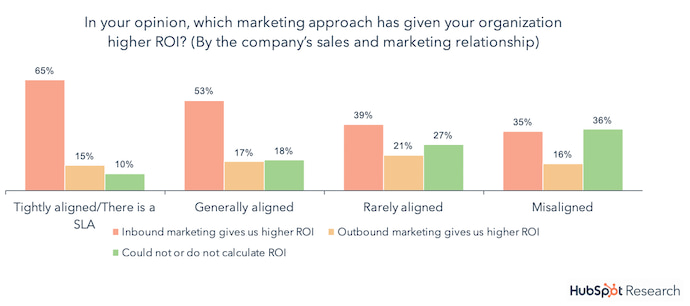
According to the 2018 State of Inbound report, fewer than half of marketers would describe their respective companies' sales and marketing teams as "generally aligned." That's a problem.

In HubSpot's early days, our marketing and sales executives started out on the same team, and luckily that collaboration has trickled down throughout the organization as it continues to grow. But it wasn't just luck, of course.

That alignment -- which we call "Smarketing" -- is largely the result of a conscious decision to work together, set goals, and create agreements between both teams.

Find out where your sales and marketing teams stand according to the 2018 State of Inbound report.

One of the most critical steps to aligning your sales and marketing efforts is creating a service level agreement (SLA). Traditionally, an SLA serves to define exactly what a customer will receive from a service provider. But SLAs serve internal operations as well, and sales and marketing agreements are among the most crucial.

SLAs are common to a business when signing on new customers. However, when one exists between sales and marketing departments, this agreement instead details marketing goals, like number of leads or revenue pipeline; and the sales activities that'll follow and support them, like engaging leads that were qualified by the marketing team.

Both the sales and marketing departments use this document as a commitment to support each other, based on concrete, numerical goals. And guess what? 65% of marketers whose companies have this type of SLA see higher return on investment from their inbound marketing efforts.
state-of-inbound-marketing-SLA

What an SLA Includes

The details of an SLA will differ among internal and external agreements. Nonetheless, there are common building blocks that each SLA should be sure to include, whether the recipient of the service is your customer or your sales team.

1. Summary of Agreement

The first item on your SLA should be an overview of the agreement. What service have you agreed to deliver to the other party? Summarize the service, to whom it's being delivered, and how the success of that service is to be measured.

2. Goals of Both Parties

In external SLAs -- those between a business and its customers -- the goals stated in the agreement are primarily those of the customer. If this is your intention, work with your client to marry their needs with the abilities of your product, and come up with a measurable goal that your company can feasibly meet for the client on a regular basis.

Is this an internal SLA between your sales and marketing departments? Both teams should have their goals outlined in this section of the contract, while making sure that when Marketing hits its goal, Sales can reach its own goal as a result.

3. What's Needed by Both Parties

SLAs should include what each party needs in order to reach their goals. In agreements that serve a customer, keep in mind their needs might go beyond simply "the product." They might need more than that to reach their goals -- such as weekly consulting, reporting, and technical maintenance from you.

SLAs between sales and marketing teams should describe what they might need from the opposite department in order to help them hit their targets. Marketing, for example, might need weekly status reports on Sales' pipeline so the marketers can adjust their lead-generating campaigns accordingly.

4. Points of Contact

Who's in charge of making sure each party's goals are met? Sort out which team does what, and who talks to whom, in this section of your SLA. Is there a separate employee using the services, in relation to the employee who reports on performance every week? Make it clear who's involved in the SLA, and how.

5. If Goals Are Not Met

You might not want to think about it, but there should always be formal consequences when a goal isn't met as part of an SLA. Don't freak out, though -- these consequences aren't always business-ending situations. Include a form of compensation to the service's end user for when the service doesn't meet their agreed-upon goals. In external SLAs, according to PandaDoc, this compensation can come in the form of "service credits." Grab PandaDoc's free SLA template here to find out more.

For Sales and Marketing SLAs, work with your sales team to establish a plan for how any lost revenue is to be made up as a result of an unreached sales quota. You might settle on a strike system that holds certain employees -- in both Sales and Marketing -- accountable for diagnosing and resolving issues of low performance.

6. Conditions of Cancellation

Under what circumstances will your SLA be terminated? Whether your contract serves a customer or two internal departments, you'll typically find yourself putting the SLA on the chopping block when it's just not working. Maybe your goals have gone unmet for the last three months, or the current agreement simply doesn't have buy-in from everyone involved.

Come up with formal conditions under which you'd cancel the current SLA in pursuit of, hopefully, a better SLA.

1. Customer Service-Level Agreement

A customer SLA is precisely what it sounds like: an agreement by a vendor to deliver a certain level of service to a particular customer. Here's a fun example:

In the TV show The Office, the company, Dunder Mifflin, supplies paper to various organizations. They might have a customer SLA stipulating that Dunder Mifflin will supply [Company X] with 50 reams of paper per month, shipped every Monday to [Address 1] and [Address 2] by Darryl Philbin -- with a confirmation of delivery sent to Jim Halpert. (Sorry, we had a little too much fun with the references in that one.)

2. Internal Service-Level Agreement

As explained earlier in this blog post, an internal SLA only concerns parties from within the company, rather than its customers. So, while a business might have an SLA open with each of its clients, it can also have a separate SLA between its sales and marketing departments.

For example, let's say Company X's sales department has to close $5,000 worth of sales per month in total, and each sale is worth $100. If the sales team's average win rate for the leads they engage with is 50%, Company X's marketing director, Josh, can work with the sales team on an SLA, stipulating that Marketing will deliver 100 qualified leads to sales director, Amy, by a certain date every month. This might include four weekly status reports per month, sent back to Josh by Amy, to ensure the leads Amy's team is receiving are helping them keep pace with their monthly sales goal.

3. Multilevel Service-Level Agreement

Multilevel SLAs can take several forms. This type of agreement can support a business's customers or the business's various internal departments. The point of this type of SLA is to outline what is expected of each party if there's more than just one service provider and one end user. Here's an example of a multi-level SLA in an internal situation:

It's a no-brainer for Company X's sales and marketing teams to partner up on an internal SLA that delivers leads from Marketing to Sales every month. But what if they wanted to incorporate a customer retention strategy into this contract, making it an SLA between Sales, Marketing, and Customer Service? After sales closes on 50 customers for the month, it's Customer Service's job to keep these customers happy and successful while using their product. In a multilevel SLA, Company X can have sales director, Amy, send monthly "customer friction" reports to Joan, the VP of service, based on dialogue the sales team has regularly with its clients. This helps the customer service team build a knowledge base that better prepares them for the pain points customers call them about. Learn more about customer service's increasing role to business growth in the HubSpot Academy.

Learn how to go from funnel to flywheel in a free HubSpot Academy video tutorial.

Now, if you don't have a Sales and Marketing SLA in place, fear not: We've outlined six steps to create one below so that you can easily start aligning your sales and marketing teams.

How to Make an SLA for Marketing and Sales Alignment

To draft your SLA, you first need to align your Sales and Marketing teams around a shared set of goals -- or, as we put it before, the harmonious "Smarketing." This alignment can then dictate the creation of a written SLA that reflects these goals. Here's how to create an SLA with "Smarketing" in mind:

1. Calculate a numerical Marketing goal based on the sales team's quotas.

As a marketing department, not only should you have a concrete goal for each campaign you run, but you also should have a high-level numerical goal that aligns with the sales team's operations. At the end of the day, that'll mean qualified leads and actual sales from those leads.

Salespeople are driven almost entirely by their sales quotas -- the numerical goals that correlate with their compensation and job security. If Marketing commits to a similar, related numerical goal, it shows that the team is being held accountable in a manner similar to Sales. The trick, however, is to make sure your numerical goal can effectively power the sales team's numerical goal.

In order to calculate the marketing side of your SLA, you'll need the following four metrics:

  • Total sales goal (in terms of revenue quota)
  • % revenue that comes from marketing-generated leads (as opposed to sales-generated ones)
  • Average sales deal size
  • Average lead-to-customer close %

Then, it's time to do some calculations:

  • Sales quota x % revenue from marketing-generated leads = Marketing-sourced revenue goal
  • Marketing-sourced revenue goal ÷ Average sales deal size = # of customers needed
  • Customers ÷ Average lead-to-customer close % = # of leads needed

2. Segment your goals by specific intervals during the year.

It might also be a good idea to reevaluate the marketing side of the SLA each month, as a variety of factors can change the numbers used in your calculations over time. To do so, create a document that tracks your SLA calculations by month, which should include the following metrics:

  • # of marketing-generated leads
  • # of those leads that became customers
  • Revenue from those closed customers
  • Total revenue closed that month from marketing-generated leads only
  • Total revenue closed that month

You will also need:

  • The average sales cycle length

With the figures above, you can re-calculate the metrics you started with on a monthly basis, or at whichever interval suits your business -- quarter, year, etc. Just make sure the same measure of time is used for both Sales and Marketing to maintain alignment. Have a look:

  • # marketing-generated leads that became customers ÷ # marketing-generated leads = lead-to-customer close %
  • Revenue from closed customers ÷ # of marketing-generated leads that became customers = sales deal size
  • Total revenue closed from marketing-generated leads / total revenue closed = % revenue from marketing-generated leads

You could also take it one step further, and incorporate quantity and quality into these metrics. The above calculations provide you with a quantitative volume goal of marketing-generated leads. However, we know that not all leads are created equal, and as a result, some may be considered higher- or lower-quality than others.

For example, a decision-making executive might be a more valuable contact than an intern. If that's the case, you can do the above analysis for each subset of leads, and set up separate goals for each type/quality level.

Want to take it even further? Measure in terms of value, instead of volume. For example, a CEO may be worth $100, for instance, while a director is $50, a manager is $40, and so on.

3. Calculate Sales's figures and their goals.

The sales side of the SLA should detail the speed and depth to which a salesperson should follow up with marketing-generated leads. When establishing this end of the SLA, consider these two sales statistics:

  • Salespeople who follow up with leads within an hour are nearly seven times more likely to have meaningful conversations with a decision maker on the other end.
  • However, only 7% of leads respond to a follow-up contact within five minutes after filling out a form.

Bottom line? Not all leads may be fit to send to Sales immediately. They often need to meet some minimum level of quality, like reaching a certain activity level, which can only take place after being nurtured by Marketing.

Nonetheless, engaging a lead the short time after he/she converts is critical to maintaining a relationship with them -- the question you have to answer is what that engagement should look like. Either Sales or Marketing should take action to start building that relationship, make nurturing easier, and set up the sales rep for success when she eventually does reach out.

Keep in mind this advice is futile if you don't consider the bandwidth of your sales reps. Sure, in a perfect world, they'd make six follow-up attempts for each lead -- in reality, though, they may simply not have enough hours in the day to do that. For that reason, you'll also need to factor in the number of leads each rep is getting (based on the Marketing SLA), how much time they spend on marketing-generated leads versus sales-generated leads, and how much time they have to spend on each one. If you're looking to conserve time, some of the follow-up -- email, in particular -- could be automated, so look into options there.

4. Set up Marketing SLA reporting.

Now that you have your SLA goals, it's time to track your progress against that goal -- daily.

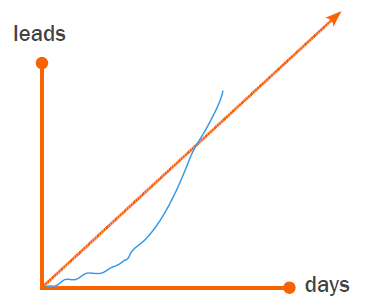
To start, graph the goal line. Multiply 1/n -- n is the number of days in the month -- by your monthly goal. That should determine what portion of your monthly goal you need to achieve each day. You'll want to graph that cumulatively throughout the month and mark your cumulative actual results on the same chart. We call that a waterfall graph, and it looks something like this:
Graph showing Marketing qualified leads on track to fulfill sales quotas

5. Set up Sales SLA reporting.

For the Sales SLA reporting, you'll have two graphs -- one monitoring the speed of follow-up, and the other monitoring the depth of follow-up.

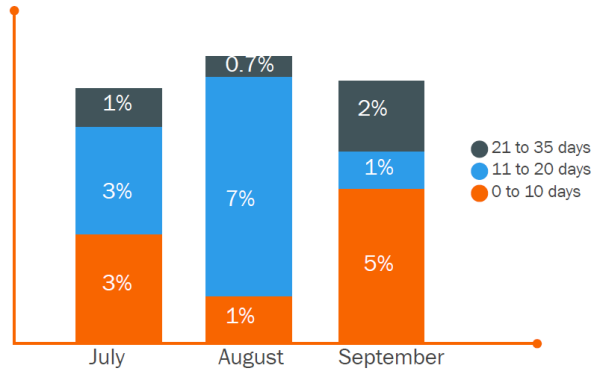
To graph the speed of follow up, you'll need the date/time the lead was presented to sales, and the date/time the lead received her first follow-up. The difference between those two times equals the time it took for Sales to follow up with that particular lead.

Take the averages of lengths of time it took for Sales to follow up with all leads within a particular timeframe -- day, week, month -- and chart it against the SLA goal.
Bar graph of monthly sales lead follow-up performance, as part of sales & marketing SLA

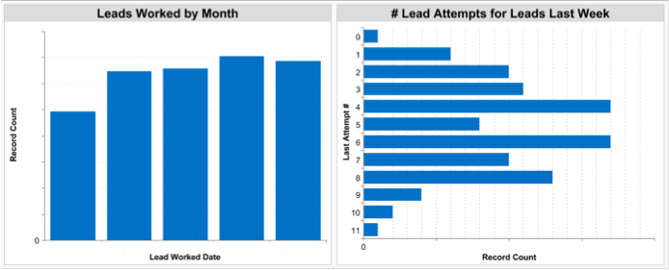
To graph the depth of follow-up -- e.g., the number of attempts -- look specifically at leads that have not been connected with, since the goal of the follow-up is to get a connect. For leads over a certain timeframe that have not gotten a connect, look at the average number of follow-up attempts made, and graph that against the SLA goal.
lead-attempts-1.png

6. Communicate, celebrate, and address the achievement (or lack thereof).

Maintaining strong communication regarding how each team is performing on goals boosts transparency. If either team isn't reaching their goals, addressing that confirms their importance, while celebrating hitting those goals can aid motivation.

If you're not sure where to begin when it comes to setting these goals, check out our free Marketing & Sales Lead Goal Calculator, designed to help you determine and track the goals that will eventually become part of your SLA.

One Last Step

When it comes to what should be in your service level agreement, there's one final piece: Review these metrics on a regular basis to monitor your progress, and make sure both Sales and Marketing have access to the reports for both sides of the SLA.

This step helps to maintain accountability and transparency and allows for both teams to address issues -- or congratulate each other on productive results.

hubspot marketing measurement assessment

Daily Search Forum Recap: January 30, 2019

Here is a recap of what happened in the search forums today...

Google+ APIs Shut Down Concerns Google My Business Developers

Yesterday, I and many developers received an email from Google Developers that had the subject line "[Action Required] Google+ APIs and OAuth requests are being shutdown on March 7, 2019." The issue is not specific with Google+ but some of those APIs in there are specific to Google My Business and they have no replacement or migration path.

Don't Block the Exit [The Customer Code Series]

This post is part 10 of 11 in a series on the HubSpot Customer Code.

If you want to see an otherwise calm and collected person switch to blind rage, ask them about a time they tried to cancel a service.

Ask me about my attempts to cancel cable.

My colleague’s gym only allowed cancellations if you showed up in-person, during business hours.

And don’t even get me started on the nightmare of cancelling magazine subscriptions.

We’ve all had these experiences. They are universally loathed, and we remember them -- and still get angry! -- one, five, even 10 years after they have happened.

But there is often a gap between what we know as a person, and what we do as a business.

Recently our COO, JD Sherman, told me about a meeting he had with one of our customer success managers. She was nearly in tears as she told him about a customer she loved working with, who also loved working with her. They’d had a long and successful relationship together. But they were in a difficult situation as a business and needed to downgrade.

The customer missed the contractual window for downgrading, and because our customer success team is incentivized on revenue retention, she was put in the position of placing her needs and the company’s needs above the customer’s.

Legally, she had everything on her side. Personally, she knew it was wrong.

At the end of their conversation, her customer said, "Okay, you've got me. I’ll pay, but after we're done with this I don't ever want to work with you again."

Wow. I am so sorry -- to both our customer and our employee.

The goals we had in place for our customer success team forced them to solve for revenue dollars instead of the success of our customers.

We were blocking the exit even though it meant destroying the relationship.

Jason Lemkin says concisely what we as humans know to be true, but we as business leaders too often forget:

If I can make a purchase with one click, I should be able to cancel that purchase with one click.

If a company makes it easy to buy, they should make it easy to stop buying.

And I’m not just saying this because it’s the right thing to do; it’s also better for business.

The HubSpot Research team asked, and 89% of consumers reported they are more likely to buy if a company makes it easy and simple to cancel.

If a customer’s meant to be, they’ll be. If they’re not meant to be, let them be.

The 9th tenet of The Customer Code is: Don’t block the exit. I give HubSpot a 7 out of 10 on this. We’ve done a lot in just the past year to improve here. Most notably, we reduced our cancellation notice window from 45 days to 10 days, but we’re not finished yet.

I want customers to be able to cancel or downgrade with a click of the button. My hope is that the experience of leaving HubSpot feels more like quitting Netflix and Spotify than it feels like cancelling a business contract -- or a cable subscription.

Not only do I want it to be easy for customers to stop paying us money, I want it to be easy for customers to take their data with them. Today, we support exports of key CRM objects. In 2019, we want to support the export of all activities associated with those exports. If it can be brought into HubSpot, we want customers to be able to take it out of HubSpot.

I don’t want anything blocking the exit, because when we block the exit, we also block the return.

This solves for customers and it solves for employees. And any change that is good for both of those groups is ultimately good for the company.

We all know that companies that retain customers grow. But companies that gracefully allow customers to leave, grow better (and leave an open door for customers to come back to them in the future).

This post is part 10 of 11 in a series on HubSpot’s Customer Code. You can find more info on The Customer Code and how we score ourselves here, and watch my INBOUND talk on this topic here:

Customer First Templates